
OMRON: Machine Safety Myths
10 Common Misconceptions to Watch Out For
Although the consequences of inadequate or misplaced machine safety practices can be severe, there are nonetheless a number of misunderstandings in existence that put many facilities – and their employees – at risk for accidents. At Omron, we assess and evaluate over 3,000 machines per year across the globe, and we’ve seen the ways in which a lack of safety knowledge and proper training can lead to poorly functioning safety systems. For this reason, we decided to investigate the causes of machine safety misconceptions and present them in a white paper format to help manufacturers better understand this important topic.
What trends are currently causing a deficit in machine safety knowledge?
Misconceptions about machine safety are currently on the rise in part because older workers are retiring in large numbers with few mid-career workers to inherit their expertise. This trend is causing many industrial facilities to lack the engineering expertise required to ensure that their machines meet modern safety standards. In addition, an increase in the prevalence of newer, fully automated solutions may in some cases lead to complacency, as manufacturers believe (mistakenly) that their new systems must be compliant. This brings us to our first machine safety myth.
June is National Safety Month: National Safety Month is observed to raise awareness about preventing injuries and deaths at work, on the road, and in homes and communities.
Myth #1: If a machine is brand new, then it must be compliant

Myth#2: Safety is too expensive, and it reduces productivity and efficiency by adding extra steps to key processes
The costs of an accident – which could be several times the initial investment in safety infrastructure – immediately demonstrate the falsehood of the above statement. These costs include not only fines and workers’ compensation, but also lost productivity due to poor morale. An on-the-job injury affects not only the injured person, but also the employees who witnessed the accident or learned of it after the fact. The stress of the event and the resentment towards an employer that failed to protect its people – particularly if the employer is found to have knowingly ignored safety standards – is likely to lead to apathy and higher turnover. To address the effect of safety measures on overall productivity, it’s important for manufacturers to note that safety measures can be designed in ways that don’t impact the efficiency of the machine. An example of this would be an application that uses a safety laser scanner to minimize downtime in areas with collaborative robots. In this scenario, if a worker enters the robot work area, the safety laser scanner will trigger the robot’s reduced speed mode and cause it to slow down to a safe operating level. When the employee steps out of the area, the robot will go back to its faster speed.
Misconceptions about administrative controls and training vs. good engineering
Some manufacturers mistakenly believe that they can substitute engineered safety solutions with enhanced training and the implementation of strict guidelines for employee behavior around dangerous machinery. Although thorough training is obviously beneficial and necessary, the presence of administrative controls alone doesn’t constitute a true safety solution. It’s not enough to simply change the way employees work; there must also be safeguarding measures in place to physically prevent them from entering the hazard zone. This brings us to our third major misconception.
Myth #3: Good administrative controls and comprehensive employee safety training can replace good engineering
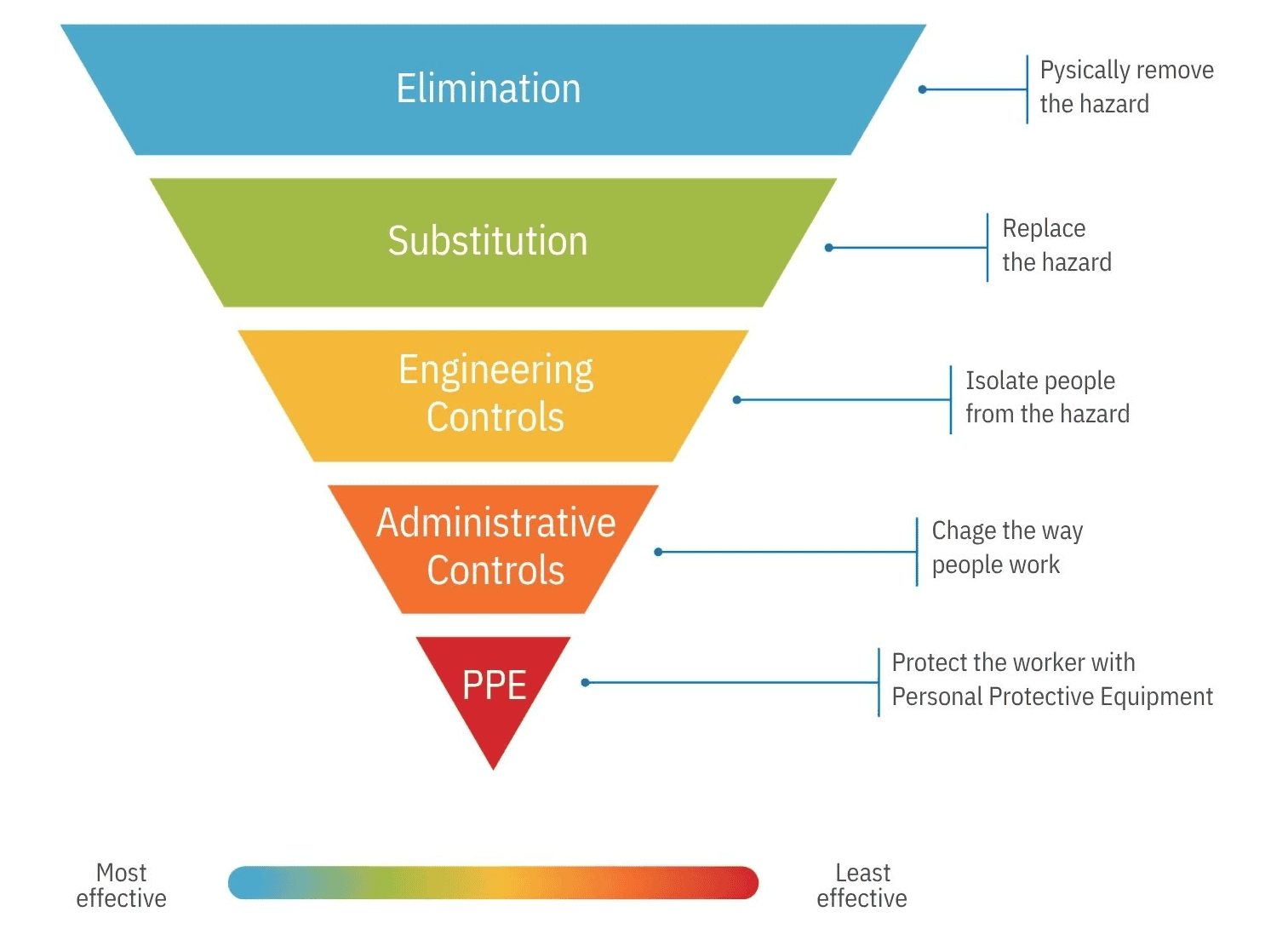
Thinking along these terms can put employees in harm’s way. The foundation of machine safety consists of a hierarchy of controls published by the National Institute for Occupational Safety and Health (NIOSH), which lists administrative controls and personal protective equipment (PPE) as the least effective ways to mitigate risk. Physically removing the hazard (“Elimination”) and replacing the hazard (“Substitution”) are the most effective measures, but these can be impractical. Engineering controls form the middle ground for protecting operators from hazardous machine motion.
The Hierarchy of Controls
What safety measures are most effective?
Myth #4: Older machines can be “grandfathered in,” so they don’t need safeguarding
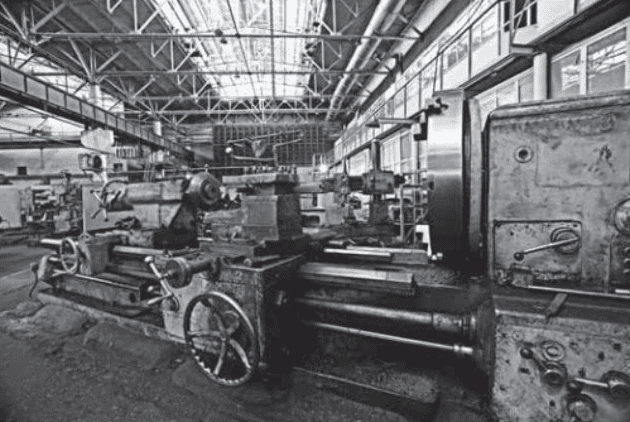
No equipment is exempt from current machineguarding standards, and so-called “grandfather clauses” simply do not exist for machine safeguarding. An exemption does exist under some robot standards, and it applies to a robot’s safety circuit integration. This very narrow exemption has led to some confusion as manufacturers mistakenly interpret it to apply more generally. The underlying reason for the resistance to retrofitting legacy equipment with current standards-compliant safeguarding is the cost. This concern also relates to another misconception that exemptions exist when there are none, this time with regards to smaller companies. Smaller manufacturers have much less cash on hand than larger manufacturers, so there’s a tendency to believe that the rules don’t apply in the same way.

Myth #5: There are machine safeguarding exemptions for smaller companies
This is false. All companies are required to safeguard their machines properly and protect the lives and safety of their employees. What may depend on company size is the amount a company is required to pay in case of a safety violation. In general, regulatory agencies see enforcement actions as way to motivate compliance, rather than simply functioning as punitive measures. Regulatory bodies often have discretion in the nature and size of an enforcement actions. They can issue a warning or a fine, or – in extreme cases – lock out noncompliant equipment. In determining the appropriate level of enforcement, the agencies will look not only at the seriousness of the infraction and whether it’s a repeat violation, but also what would be necessary (within statutory limitations) to motivate the offending company to bring its equipment into compliance. In this current year, OSHA fines have ranged from $964 to $13,494 per serious violation (2020 data).
Misconceptions about identical machines and machines that have been moved
Another way that some companies seek to cut corners is to avoid performing risk assessments on machines that are very similar or that have been moved or modified slightly. This brings us to machine safety myths #6 and #7.
Myth #6: When several machines are identical, it’s only necessary to do a risk assessment for one of them
This is not necessarily true; it depends on the complexity of the machine. Even seemingly insignificant differences between machines and their positioning relative to one another could change the outcome of a risk assessment. For instance, the addition of a small step to one of several otherwise identical machines could be sufficient to place a worker in harm’s way.
Myth #7: If a machine was assessed for risk before it was moved to a new location, there’s no need to do another risk assessment
As with the previous myth, this depends on the complexity of the machine. Moving it to a new location could create a requirement for a new risk assessment. When assessing access to a hazard on a machine, Omron’s safety experts uses a system known by the acronym “AUTO” to determine whether an employee can reach around, under, through or over a safeguarding measure to reach a hazard area. When a machine is first assessed in its original location, there may have be a wall or another structure blocking access to part of it. Once it’s placed in a new location, the immediate surroundings may not block access in the same way, giving employees have unrestricted access to the hazard. Similarly, the new location may include nearby steps that allow someone to reach over a guard in a way that they couldn’t have done previously.

Engineering-specific machine safety misconceptions
The more technical aspects of a safety system can also be rife with misunderstandings. Here are a couple of the more frequent ones we’ve come across during our risk assessments.
Myth #8: A gate using a padlock to prevent access is an acceptable and sufficient safety measure
This is false. Movable guards providing protection against hazards need to be interlocked to signal the apparatus to stop. Fixed guards should be securely held in place either permanently (by welding, for example) or by means of tamper-resistant fasteners that make it impossible to open the guards without using tools that aren’t readily available to operators on the manufacturing floor. Since the guards must never remain closed without their fasteners, a gate must be fastened shut or interlocked.
Myth #9: Performance requirements for safety measures stop at the wire
This misconception has to do with the ways in which various energy sources must be safeguarded. Many manufacturers believe that safeguarding is only necessary when the energy source is electrical. As it turns out, all hazardous energy sources need to be “single-fault tolerant,” including hydraulic and pneumatic sources.
What to look for in an assessment service provider
Myth #10: Safety is something you can just take care of once and then forget about.
This is completely false. Safety is an ongoing requirement, and companies must have regular risk assessments performed on their machines to ensure that they meet the most recent safety standards. Standards evolve with the purpose of making workplaces safer, and it’s imperative for manufacturers to stay up to date and protect their employees.

Summary
We hope that this white paper clarifies not only the need for regular risk assessments, but also the importance of seeing past the common safety misconceptions to understand what’s actually needed to protect workers in manufacturing environments. When it’s not feasible to completely remove a hazard, manufacturers must put the appropriate engineering controls in place to isolate the danger source from the operator. There’s no justification for cutting corners in this situation, and it’s not worth the risk (and financial penalties) of a serious on-the-job accident. A robust and frequently updated safety solution is always a worthwhile investment.